For multifamily owners, learning how to streamline property maintenance is less about asking teams to work faster and more about removing uncertainty from each handoff. A clear process helps staff capture requests consistently, respond according to risk, coordinate vendors, and show owners what was completed. The result is a maintenance operation that is easier to oversee and less likely to lose work between intake and closeout.
Discuss your property management needs
This guide focuses on workflow design and operating measures for multifamily assets. It is not a substitute for local code requirements, equipment instructions, emergency procedures, or qualified technical judgment. Build the process around the building, staffing model, lease obligations, and resident needs you actually have.
Where does maintenance friction usually begin?
Answer: Maintenance friction often starts when a request arrives through one channel, is described inconsistently, or has no clear owner. The team then spends time clarifying the issue, deciding who should act, and finding out whether anyone followed up. A sound workflow makes the next action visible from the moment the request is received.
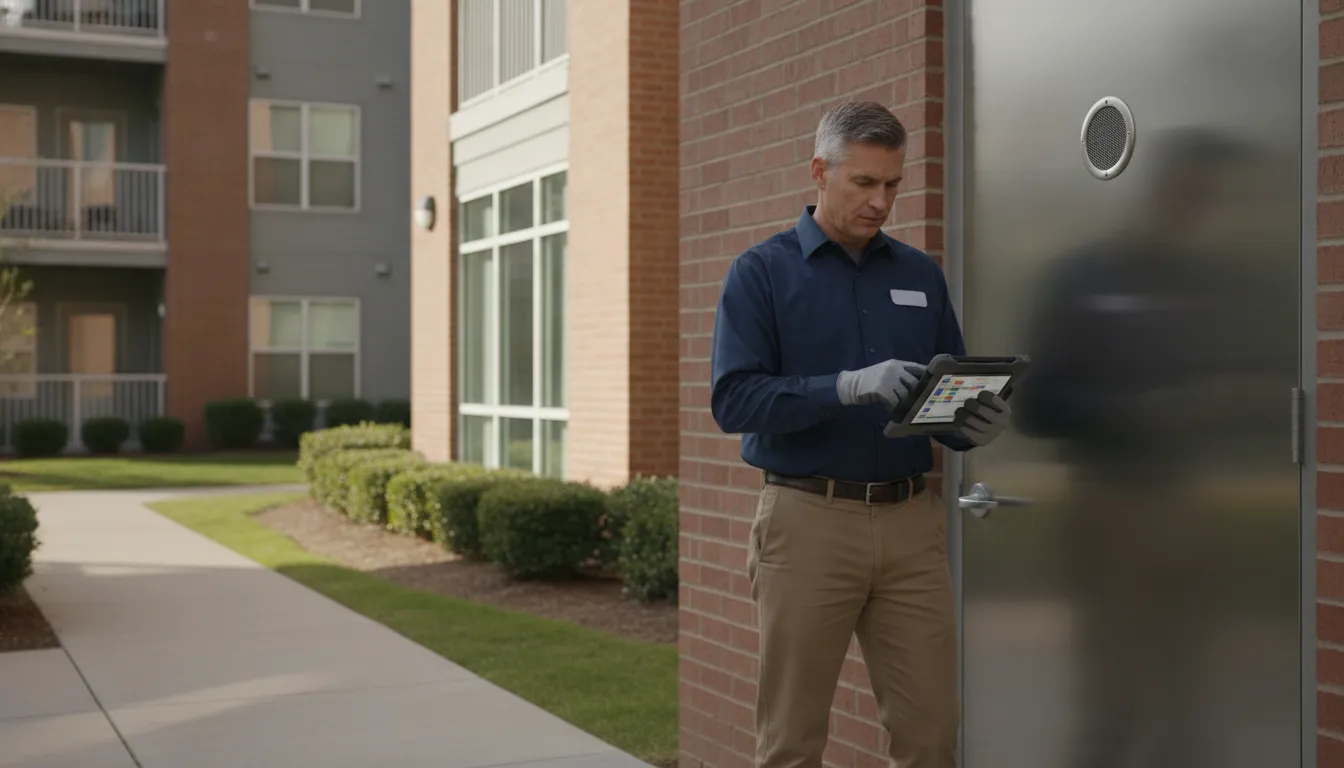
Consider a resident who reports water near a kitchen sink by phone. If the note says only “plumbing issue,” the team may not know whether the water is actively spreading, whether the sink is usable, or whether access has been arranged. A short, consistent intake form can capture those details before a technician is dispatched. This does not mean every request needs a long questionnaire. It means collecting the information that changes urgency, access, safety, or the likely assignment.
Map the current path of a typical work order before changing software or adding rules. Follow one request from its first report through assignment, work, resident update, completion, and any invoice or owner review. Note where it waits, gets re-entered, is sent back for clarification, or disappears from view. These handoff points are often better improvement targets than the number of work orders alone.
- Fragmented intake: Requests come by phone, email, resident portal, and in-person conversations without a shared record.
- Unclear urgency: Staff use different definitions of emergency, urgent, and routine.
- Unassigned ownership: The request is logged, but no person or team is responsible for the next step.
- Repeated follow-up: Residents or owners must ask for status because updates are not part of the process.
- Unverified closeout: A work order is marked complete without a clear record of the work performed or remaining action.
For owners reviewing the broader service model, the overview of what property management includes can help distinguish day-to-day execution from owner oversight. For this workflow, the key is to assign one accountable next step at every stage.
How can a property team standardize request intake?
Use a consistent intake record whether a request begins in a portal, by phone, or during a property walk. At minimum, capture the property and unit or common area, date and time, issue description, reporter, access instructions, known safety concerns, and preferred contact method. If photos or video are submitted, attach them to the same record rather than leaving them in a separate inbox.
A good intake process should also establish what happens when the preferred channel is unavailable. Staff need a reliable fallback for urgent reports, along with a rule for entering that report into the shared work-order record afterward. Otherwise, a backup channel can become a second untracked queue.
- Receive and acknowledge. Confirm that the report has been received and explain what happens next. An acknowledgment is not a promise about a repair time.
- Clarify only what changes the action. Ask whether the condition is active, whether anyone may be at risk, whether an essential service is affected, and how staff can access the area.
- Create one durable record. Give the request a unique identifier and keep messages, photos, assignments, and status changes with it.
- Assign a named next owner. The owner may be a maintenance lead, property manager, or approved vendor coordinator. “The team” is not an assignment.
- Set the next update point. Record when the requester should expect an update, especially if diagnosis or parts could delay completion.
Use short issue categories that help routing rather than an elaborate taxonomy nobody maintains. A practical starting set might include plumbing, electrical, HVAC, appliances, building envelope, life-safety concern, access, housekeeping, and grounds. Add subcategories only when they change who receives the work, what information is needed, or how results are reviewed.
Work-order tools can support the process, but software does not resolve inconsistent ownership by itself. Set required fields, status definitions, and notification rules to match the agreed workflow. If reviewing systems, compare the operational capabilities and data needs in a property management technology stack rather than choosing a tool based only on its feature list.
How should maintenance requests be prioritized?
Prioritize by risk and impact, not by who follows up most often. Write down the criteria that determine the response path and train staff to apply them consistently. The precise thresholds should reflect applicable law, property procedures, equipment guidance, and qualified professional advice.
A useful triage decision considers four questions: Is there an immediate threat to people or property? Is an essential service unavailable? Is the condition spreading or likely to worsen quickly? How many residents or building areas are affected? The answers inform the response category; they do not replace emergency services or technical assessment when those are needed.
| Work category | Typical signals | Initial workflow | Owner visibility |
|---|---|---|---|
| Emergency. | Immediate danger, active uncontrolled damage, or another condition covered by the property's emergency procedures. | Follow the established emergency protocol; notify the responsible lead and qualified responders; document actions as soon as practical. | Prompt notification through the agreed escalation path. |
| Urgent. | Important service disruption or a condition likely to worsen before routine scheduling. | Assign promptly, confirm access and needed expertise, and provide a clear status update. | Escalate if response or parts are delayed beyond the defined threshold. |
| Routine. | Localized issue that does not present an immediate risk and can be scheduled. | Group by trade, location, access window, and available capacity where practical. | Include in normal work-order and aging reviews. |
| Planned work. | Recurring service, scheduled inspection, or approved repair or improvement. | Place on the calendar, confirm scope and approvals, and track completion evidence. | Review against schedule, budget, and asset priorities. |
The examples in the table are prompts for policy design, not universal classifications. A slow leak can become urgent if it reaches electrical equipment or damages another unit. A broken appliance may affect one household, while a common-area system failure can affect many. Train staff to reassess when new information arrives, and preserve the reason for any priority change in the work-order history.
Make escalation rules explicit. State who can authorize an after-hours vendor, who contacts residents when access is needed, and who informs ownership about a material event. Avoid relying on memory or a single employee's personal contact list. The vendor management process should be aligned with the same escalation plan.
How can vendor handoffs become more reliable?
Vendor coordination works best when every assignment contains enough information for the vendor to accept, plan, and document the work. A bare description such as “check HVAC” can lead to return visits, unclear invoices, and disputes about scope. Before dispatch, provide the location, reported symptoms, access instructions, known constraints, priority, and any relevant equipment or prior-work details that are available.
Set basic service standards before a problem occurs. Standards can cover acknowledgment, arrival coordination, resident communication, work authorization, documentation, invoice detail, and notification when a job cannot be completed. Keep the requirements proportionate to the work and consistent with contracts, law, and property policies. For recurring or specialized work, clarify who supplies parts, who obtains approvals, and who confirms that the work meets the agreed scope.
- Use a defined dispatch packet. Send the work-order number, issue summary, location, access details, priority, and appropriate contact information.
- Confirm acceptance. Record whether the assignment is accepted and what follow-up or site access is required.
- Control scope changes. Require a clear estimate or authorization step when the work expands beyond the approved scope, except where an established emergency protocol applies.
- Capture completion evidence. Request concise notes on diagnosis, work performed, materials or parts where relevant, unresolved issues, and recommended follow-up.
- Close the loop. Have an authorized staff member review the record, update the requester, and route invoice or approval items through the normal process.
Track exceptions as carefully as successful jobs. A declined assignment, missed access, return visit, or unavailable part may point to a process issue. Separate vendor performance from factors outside the vendor's control, such as incomplete intake or resident access. This makes review more useful and fair.
Property owners who want an overview of operating responsibilities can review HH Red Stone's third-party property management services. Owners with a larger or mixed portfolio can also examine the portfolio overview as context for the company's property-management experience; it should not be treated as a promise about a specific asset's staffing or results.
How do preventive schedules and inspections fit the workflow?
Reactive work will never disappear, but a calendar for recurring tasks can make the workload more predictable and expose issues before they become larger jobs. Start by inventorying equipment and building elements, gathering available manufacturer guidance, service history, warranty information, and any applicable inspection requirements. Assign an accountable role to each recurring task and record the evidence needed to show it was completed.
Separate recurring preventive tasks from condition-based follow-up and capital work. For example, a routine equipment service belongs on the recurring schedule; a finding during that service should create a linked corrective work order; a larger renewal or replacement may need owner review and capital planning. Keeping those records connected helps avoid counting an inspection as a completed repair.
Build the schedule around actual operating constraints. Consider seasonal demand, vendor availability, resident access, academic-year turnover where relevant, and the need to coordinate related work. Student housing teams may find it useful to align planned maintenance with the broader sequence described in this student housing turnover planning guide, while still reserving capacity for issues that arise during occupancy.
Inspections add value when findings lead to decisions. Use a simple record that notes location, observed condition, date, photos when appropriate, recommended next action, priority, and responsible person. Then route each finding to one of three paths: immediate escalation under policy, a routine work order, or evaluation for planned or capital work. An inspection list without assigned follow-up becomes another untracked queue.
For recurring building work, compare the schedule with the property's multifamily maintenance planning approach and its preventive maintenance program framework. Larger repairs or renewals may need a separate decision and funding track, such as the steps in a capital improvement plan. These processes should connect without treating every maintenance request as a capital project.
Which maintenance measures help owners find bottlenecks?
Use a small set of measures that supports decisions, not a dashboard full of numbers without an owner. Define each measure precisely, use a consistent time window, and separate emergency, routine, and planned work where that distinction changes interpretation. A metric is useful when someone can explain what action follows a change.
- Time to acknowledge: Elapsed time from intake to recorded acknowledgment. This shows whether requests are being seen; it does not prove the repair is underway.
- Time to assignment: Elapsed time between record creation and assignment to a staff member or vendor. A long interval may indicate triage or capacity friction.
- Age of open work orders: Count or share of open work orders grouped by age and priority. Review the oldest items, not just the average.
- First-visit completion: Share of assigned jobs completed without a return visit, defined consistently and interpreted by work type. A lower result may reflect missing diagnosis, parts, access, or technical complexity.
- Repeat requests: Work orders tied to the same location or issue within a defined period. Review whether the repair resolved the cause or only the symptom.
- Preventive schedule completion: Share of scheduled tasks completed in the intended period, with exceptions and reschedules recorded.
- Cost by work type or asset: Review costs with scope and building context. Cost alone does not show whether work was necessary, timely, or effective.
Avoid setting targets before the data definitions and baseline are stable. For example, “close work orders faster” can encourage premature closure if completion criteria are vague. Pair speed measures with quality checks, repeat work, resident updates, and unresolved items. Compare like with like: a routine light replacement and a complicated water intrusion investigation should not be treated as equivalent jobs.
Use a regular review rhythm. A weekly operations review can focus on emergencies, aging items, access blocks, and vendor exceptions. A monthly owner review can summarize volume, recurring causes, preventive schedule status, material costs, and decisions needed. The monthly reporting guide and property management KPI guide offer related ways to structure reporting. Keep the underlying work-order detail available so a summary can be checked.
How to streamline property maintenance without disrupting operations
Change one part of the workflow at a time, then check whether the handoff actually improved. A practical first month might focus on intake fields, priority definitions, or open-work-order review, not all three at once. Explain the reason for the change, who owns it, and where staff should record exceptions. If an existing process has a safety or compliance gap, address that through the appropriate immediate channel rather than waiting for a gradual improvement cycle.
- Establish a baseline. Review a representative set of recent work orders across property areas, priorities, and trades. Note missing information and repeat handoffs.
- Select one friction point. Choose a problem that can be observed, such as unassigned requests or incomplete vendor closeout notes.
- Write the new rule in plain language. Specify the trigger, accountable role, required record, escalation route, and exception path.
- Test it on a manageable scope. Apply the rule to a building, work category, or short period that allows staff feedback without losing visibility.
- Review both outcome and workload. Check whether delays, repeat visits, or missing updates changed, and whether the new step created avoidable effort.
- Revise and document. Keep what works, adjust unclear instructions, and make the updated process accessible to staff and vendors who need it.
Owners should define which decisions require approval and which sit within an agreed operating scope. Examples include a spending threshold, a change in repair scope, a planned replacement, or a material resident impact. The exact authority should be set in the management agreement and property procedures; this article does not establish approval limits. A transparent approval path prevents both unnecessary pauses and commitments made without authority.
For multifamily properties, maintenance workflow is also a resident-service process. Give residents a predictable way to report issues, explain how urgent problems should be handled, and close the loop when a repair is finished or delayed. At the same time, protect staff capacity by keeping communication factual and avoiding commitments before scope, access, or parts are confirmed. If you are comparing management scope for a multifamily asset, the multifamily property management page provides a relevant starting point.
Talk with HH Red Stone about your property
Frequently asked questions
What is the first step to streamline property maintenance?
Map how a request moves from initial report to verified completion. Identify where information is missing, ownership changes, or status becomes hard to see. Fix the most consequential handoff before adding more tools or metrics.
Should every maintenance request use the same priority?
No. Use written categories based on safety, damage risk, service impact, and the number of people or areas affected. Train staff to reassess a request when new facts change its risk, and follow the property's emergency procedures and applicable requirements.
Which details should a maintenance work order include?
Record the location, issue, report time, reporter, access information, priority, responsible next owner, status updates, work performed, and any remaining action. Include photos or vendor notes when they help explain the condition or document closeout.
How often should owners review open work orders?
Set a cadence that matches the size and activity of the property. Many teams separate frequent operational checks of urgent and aging work from a broader monthly review of trends, costs, repeat issues, and approvals. The review should have a named owner and a clear route for escalation.
Does property management software automatically streamline maintenance?
No. Software can centralize requests, assignments, and status history, but it cannot decide appropriate priorities or clarify who has authority. Define the workflow first, then configure the system to support it and review whether staff can use it consistently.
How can an owner tell whether a process change worked?
Compare a consistent baseline and follow-up period using measures tied to the change, such as unassigned requests, aging work orders, repeat visits, or missing closeout records. Check work quality and staff workload alongside speed, and investigate differences in job type or property conditions before drawing conclusions.
A dependable maintenance operation makes requests visible, assigns each next step, and records what happened. Owners can then use evidence from the workflow to address recurring friction while keeping safety, resident communication, and the condition of the asset at the center of each decision.